




Medicaid → Medicaid Coverage → Determining the Medicaid Enrolled Provider Type
Determining Which Providers Can Deliver and be Reimbursed for the National DPP in Medicaid
State Medicaid agencies must determine which types of providers can deliver National Diabetes Prevention Program (National DPP) lifestyle change program services, including which types of entities can enroll in Medicaid as National DPP lifestyle change program providers, and which types of entities can bill Medicaid for delivering the services. This page contains the following content to help state Medicaid agencies consider how to make these determinations.
- Existing vs. New Provider Types
- National Provider Identifier
- Billing vs. Rendering Providers
- Managed Care Considerations
- State Examples of Medicaid Providers Delivering the National DPP Lifestyle Change Program
- Considerations for Choosing Existing vs. New Provider Types
Existing vs. New Provider Types
Most traditional Medicaid enrolled providers are licensed professionals, and many states do not have experience enrolling non-licensed personnel* like CDC-recognized organizations and their Lifestyle Coaches (although this is evolving). States can either use an existing provider type to deliver the National DPP lifestyle change program or create a new provider type, and there are pros and cons to both approaches. This section of the page attempts to define these two approaches with more details later in the Considerations for Choosing Existing vs. New Provider Types section.
*Under the Preventive Services Rule Change to 42 CFR 440.130(c) issued by the Centers for Medicare & Medicaid Services (CMS) in 2013, states can offer Medicaid services that are provided by non-licensed staff. For more information about the Preventive Services Rule Change, see the Center for Medicaid & CHIP Services (CMCS) Information Bulletin and a presentation prepared by CMS entitled, “Medicaid Preventive Services: Regulatory Change.” For additional information about this policy, please review the Attaining Coverage Through a Medicaid State Plan page.
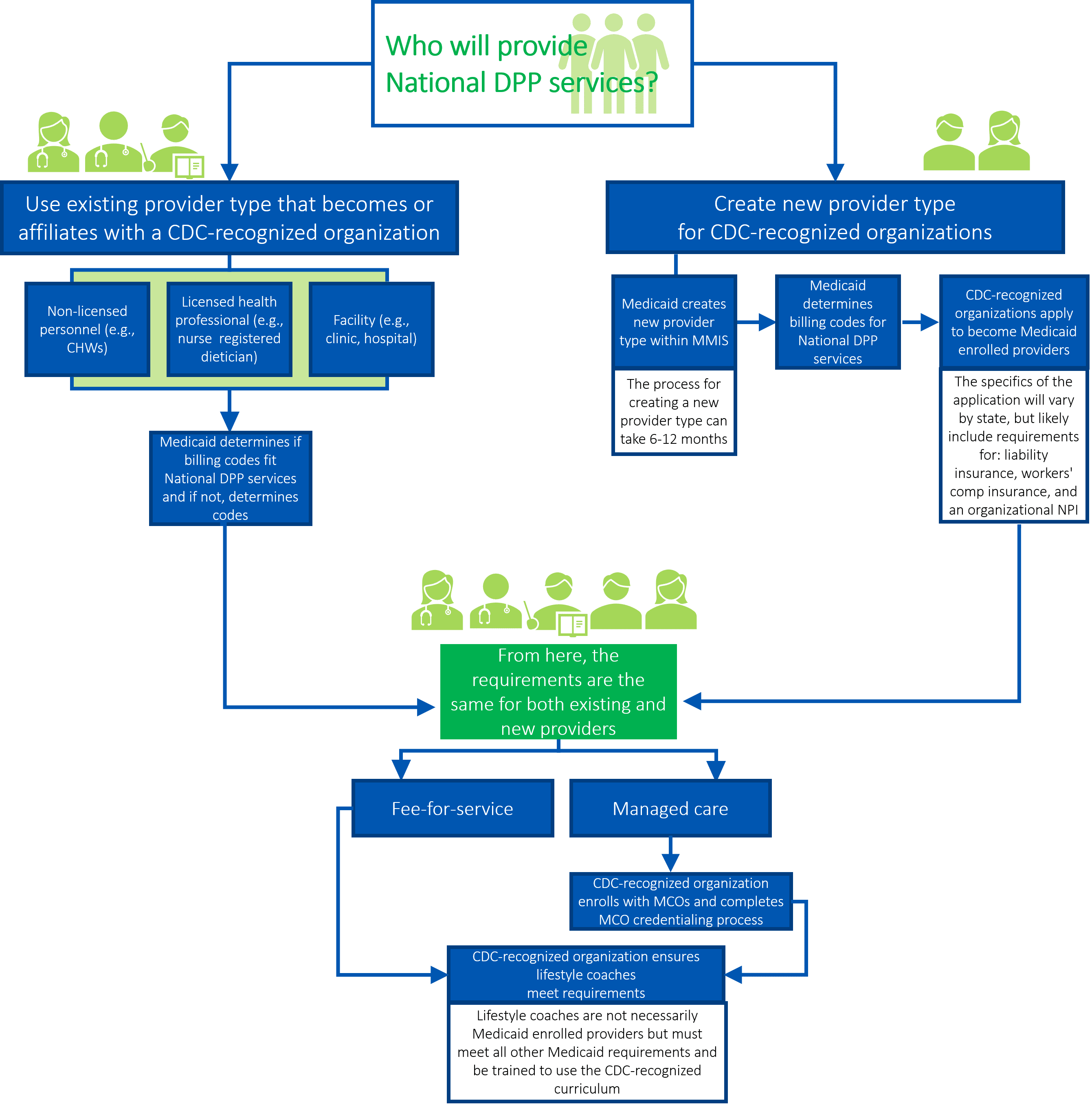
Existing providers: Medicaid can designate existing provider types (already authorized as Medicaid providers) as eligible to deliver National DPP lifestyle change program services. This can be done through administrative rules or other Medicaid policy changes. Any existing providers that provide National DPP lifestyle change program services will also need to become or affiliate with a CDC-recognized organization. Examples include:
- Health care facilities: health systems, hospitals, federally qualified health centers (FQHCs), community health centers, etc.
- Licensed health care professionals: physicians, advance practice registered nurses (APRNs), nurses, registered dietitians, and other licensed practitioners who are already approved to render Medicaid services.
- Non-licensed personnel: community health workers (CHWs), etc.
New providers: Like Medicare did for the Medicare Diabetes Prevention Program (MDPP) when they created an MDPP supplier type to offer the program, states can elect to create a new provider type that would allow more traditional CDC-recognized organizations (e.g., community-based organizations or CBOs) to enroll in Medicaid and deliver National DPP lifestyle change program services. Creating a new provider type gives states the advantage of enrolling providers that have experience with and are specifically focused on delivering the National DPP lifestyle change program. Some states have found it eases challenges in the long run by creating a standardized and transparent way for CBOs to become Medicaid providers and receive reimbursement, which in turn can support sustainability of the program.
Like MDPP suppliers, state Medicaid agencies that have created a new provider type for CDC-recognized organizations have done so at the ‘organization level.’ The CDC-recognized organization enrolls with Medicaid, and then the Lifestyle Coaches employed by the CDC-recognized organization deliver the program to Medicaid beneficiaries.
The graphic at the bottom of the page depicts some key decisions involved in using an existing provider type and creating a new provider type.
National Provider Identifier
To be reimbursed for delivering covered services to Medicaid beneficiaries, providers need to obtain a National Provider Identifier (NPI). The NPI is a 10-digit number assigned by CMS to HIPAA covered health care providers. Additional information about NPI numbers, including FAQs and information on how to apply for an NPI, can be found on CMS’ website.
A CDC-recognized organization must obtain an NPI to enroll as a Medicaid provider (as in the ‘New providers’ example above), and they will use that NPI to bill Medicaid for the National DPP lifestyle change program services their Lifestyle Coaches offer to eligible Medicaid beneficiaries. The Lifestyle Coaches employed by the CDC-recognized organization may also be required to obtain NPIs by the Medicaid agency (like they are required to do by Medicare in the case of MDPP suppliers). This requirement is for identifying Lifestyle Coaches associated with Medicaid enrolled providers, but a Lifestyle Coach’s NPI is not used for billing. Only the NPI associated with the enrolled Medicaid provider (i.e., the CDC-recognized organization) is used for billing. In this example, the CDC-recognized organization is the billing provider, and the Lifestyle Coach is the rendering provider. Please see below to learn more about billing vs. rendering providers.
Billing vs. Rendering Providers
As states decide which providers can deliver program services, they will also need to develop the distinct processes involved with billing. Some states may utilize different billing and rendering providers to support the National DPP lifestyle change program delivery. In this scenario, billing providers bill and are reimbursed by Medicaid for the services provided by the rendering providers.
Billing providers are responsible for submitting the claims and invoices for reimbursement on behalf of the rendering provider. The billing provider must be enrolled as a Medicaid provider and may also be the rendering provider. All billing providers must ensure accurate and timely submission of claims to Medicaid and other third-party payers.
Rendering providers are responsible for delivering National DPP lifestyle change program services to the Medicaid beneficiary. Rendering providers are typically licensed and credentialed; however, a rendering provider may also be a non-licensed personnel member (i.e., a Lifestyle Coach) specifically designated to provide National DPP lifestyle change program services under the supervision of the billing provider (i.e., the CDC-recognized organization).
Managed Care Considerations
Managed care organizations (MCOs) will have their own provider credentialing and billing processes in addition to any provider qualifications and payment processes directed by the state Medicaid agency. The MCO will contract with providers to provide the National DPP lifestyle change program services to their members. See the MCO Contracting page of the Coverage Toolkit for more information on:
- Contracting between MCOs and CDC-recognized organizations
- MCOs’ credentialing CDC-recognized organizations
- Negotiating reimbursement for CDC-recognized organizations
The Coverage Toolkit’s Engaging MCOs page and Building Network Capacity page contain additional information on working with MCOs and Medicaid managed care network management rules.
State Examples of Medicaid Providers Delivering the National DPP Lifestyle Change Program
Please find state examples of Medicaid providers delivering National DPP lifestyle change program services to Medicaid beneficiaries in the tabbed table below.
California
California: Licensed Health Care Professionals and CDC-Recognized Organizations
In California, CDC-recognized organizations can enroll in Medi-Cal (California’s Medicaid agency). The Medi-Cal Diabetes Prevention Program webpage offers information about which Medi-Cal provider types may render National DPP lifestyle change program services for both the fee-for-service (FFS) and the managed care delivery systems. These include home health agencies, physicians, physician groups, FQHCs, community hospitals, and CDC-recognized organizations among others.
Medi-Cal National DPP providers may use peer coaches (i.e., Lifestyle Coaches) to provide National DPP lifestyle change program services to Medi-Cal beneficiaries. These peer coaches are required to obtain and maintain a valid NPI. Physicians, non-physician practitioners, or unlicensed persons can serve as peer coaches. Unlicensed peer coaches must have an arrangement with a Medi-Cal National DPP provider to receive reimbursement for rendering National DPP lifestyle change program services to Medi-Cal beneficiaries.
Maryland
Maryland: CDC-Recognized Organizations
In Maryland, CDC-recognized organizations enroll in Medicaid as the National DPP provider and bill Medicaid for the services provided by their Lifestyle Coaches. The CDC-recognized organization’s NPI is used for billing and reimbursement purposes. The individual Lifestyle Coaches are associated with the Medicaid enrolled CDC-recognized organization and provide services to Maryland’s Medicaid beneficiaries, but they are not required to formally enroll in Medicaid as providers. Instead, the CDC-recognized organization attests that its Lifestyle Coaches comply with the CDC’s Diabetes Prevention and Recognition Program (DPRP) rules. It is also not required by Maryland Medicaid that Lifestyle Coaches obtain an individual NPI (although it is recommended).
Montana
Montana: Licensed Health Professionals
In Montana, physicians, mid-level practitioners, and registered dietitians (who also hold a current Montana license as a nutritionist), are approved, among a list of other provider types, to receive Medicaid reimbursement for providing National DPP lifestyle change program services.
Oregon
Oregon: Managed Care Organizations
In Oregon, local coordinated care organizations (CCOs), Oregon’s version of an MCO, can contract with CDC-recognized organizations to deliver the program to their members. To learn more about Oregon’s benefit, please visit the Oregon Health Authority’s National DPP website or read through their Medicaid Benefits in Oregon for the National DPP guide.
Considerations for Choosing Existing vs. New Provider Types
Click one of the green buttons below to learn more about what a state will need to do if they use an existing provider type or create a new provider type. Please download this summary document to understand the pros and cons of using an existing provider type and creating a new provider type.
Please note that regardless of whether Medicaid is using an existing provider type or creating a new provider type, the Medicaid agency will have to determine the mode of delivery for the National DPP lifestyle change program: in-person, online, distance learning, and/or combination.